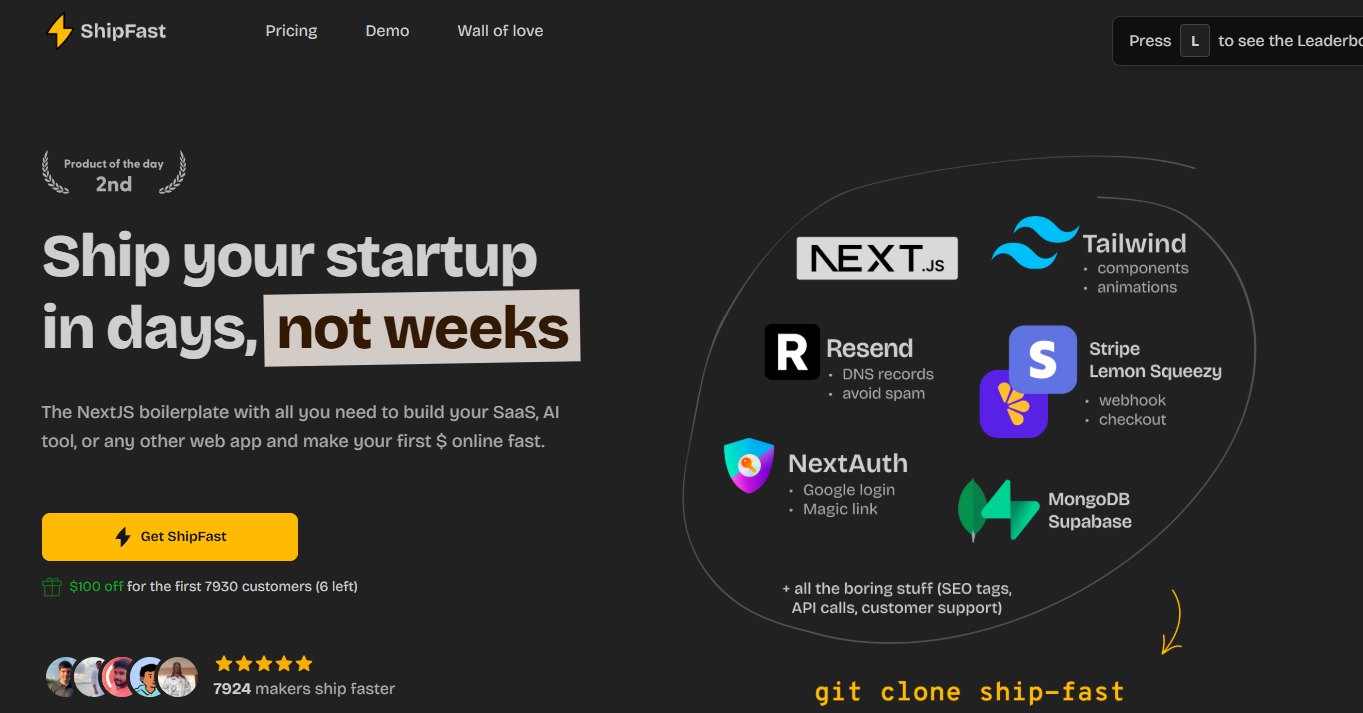
Imagine building a fully functional SaaS product in under an hour. No backend headaches, no authentication nightmares, no payment integration struggles. ShipFast makes this possible, and in this comprehensive 2026 review, we’ll explore whether this Next.js boilerplate is worth your investment.
What Is ShipFast?
ShipFast is a pre-built Next.js SaaS boilerplate created by Marc Lou that enables solo founders to launch full-stack MVPs with authentication, payments, and email systems in under 60 minutes. Built on Next.js and Tailwind CSS, it packs over 50 pre-built features that handle everything from user authentication to subscription billing.
Marc Lou brings serious credibility with his track record of 10+ successful launches, and over 5,000 founders have used ShipFast to build products generating more than $1 million in monthly recurring revenue. These aren’t just side projects—they’re real businesses solving real problems.
Core Features That Save You Weeks
ShipFast eliminates the tedious setup work that typically consumes weeks of development time. Here’s what comes out of the box:
Authentication System: Clerk integration provides SSO-ready authentication with JWT tokens, session management, and CSRF protection automatically configured. No more spending days figuring out secure login flows.
Payment Processing: Stripe integration supports subscription billing, one-time purchases, coupons, and abandoned cart recovery. The webhook handler is pre-built, ensuring secure payment processing from day one.
Database Setup: Supabase provides PostgreSQL storage with real-time queries and automatic backups. The connection takes just two minutes to configure.
Email Notifications: Resend integration enables drip campaigns, personalization, and DKIM authentication in under a minute.
Landing Pages: Multiple responsive templates built with Tailwind CSS include SEO optimization and A/B testing capabilities right out of the box.
AI Integration: OpenAI-powered chatbot features with prompt engineering and analytics come pre-configured.
The standout feature is the zero-config deployment to Vercel, which typically completes in 90 seconds. You can also deploy to Netlify, Render, or Fly.io with equal ease.
Game-Changing 2026 Updates
The 2026 update transforms ShipFast from an already impressive tool into something exceptional. These updates reduce MVP launch time from two weeks to just three days:
AI Assistant Builder: Automates code generation with 85% efficiency, creating custom React components and email sequences without manual coding.
PWA Support with Push Notifications: Beta testers reported a 40% boost in retention rates thanks to offline mode and push notification capabilities.
GraphQL and tRPC Integration: Delivers 60% faster queries through optimized API routes and webhook handlers for real-time data.
Clerk v5 with Organizations: Adds team features, Auth0 SSO, and multi-user session management for collaborative projects.
Edge Functions Support: Powers serverless architecture with Vercel and Cloudflare, enabling global performance through ISR caching.
Native Zapier Integration: Connects to thousands of apps without code, enabling powerful automation workflows.
SOC2 Compliance Templates: Includes security checklists covering OWASP top 10 vulnerabilities and rate limiting.
These enhancements position ShipFast as more than just a boilerplate—it’s a complete startup launch platform.
Launch Process: From Zero to Live in 15 Minutes
ShipFast streamlines startup launches through a simple seven-step process. Here’s the complete workflow:
- Clone the repository (30 seconds): Fork the GitHub repo to your account
- Install dependencies (2 minutes): Run npm install to set up the project
- Configure environment variables (3 minutes): Set up Supabase URL and keys
- Set up authentication (2 minutes): Add Clerk publishable and secret keys
- Configure payments (1 minute): Add Stripe test keys and webhook secrets
- Deploy to Vercel (90 seconds): One-click deployment with automatic CI/CD
- Add custom domain (5 minutes): Configure DNS records and go live
Total setup time stays under 15 minutes, with clear video tutorials guiding each step. Common errors like mismatched environment variables or missing API keys are easily fixed with the included troubleshooting checklist.
Real Success Stories
The proof is in the results. TaskMagic, built by Marc Lou using ShipFast, hit $12,000 in monthly recurring revenue within 90 days. The app combined ShipFast’s foundation with AI features for task automation, focusing on product logic rather than infrastructure.
Pieter Levels launched CloneSaaS using ShipFast and reached $8,000 MRR in just 14 days. He leveraged the pre-built authentication system and payment gateway, customizing React components for his cloning interface.
FeedbackFlow grew to 1,200 users and $4,200 MRR using ShipFast’s form builder and analytics dashboard. The team achieved 500 users in 30 days through the landing page builder and email sequences.
NicheTool, an agency management SaaS, reached $19,000 in annual recurring revenue by integrating invoice generation and project management features. The founder specifically praised ShipFast’s scalability for powering their growth.
Pricing That Makes Sense
ShipFast offers three lifetime plans with no recurring fees:
Starter ($99): Perfect for solo founders building their first MVP. Includes basic authentication, landing pages, and core components for one project.
Pro ($199): The sweet spot for indie hackers launching paid SaaS products. Includes Stripe integration, AI tools, Supabase backend, and supports up to five projects with 50+ premium components.
Agency ($399): Built for teams and agencies scaling client projects. Offers unlimited projects with white-label options, custom domains, and team collaboration features.
All plans include a 30-day money-back guarantee. Compared to monthly alternatives like Bubble ($32/month) or Adalo ($50/month), ShipFast delivers superior value. A $99 Starter plan beats $500+ in development time for a basic web app, breaking even after just one launch.
Strengths and Limitations
What ShipFast Does Exceptionally Well:
ShipFast apps consistently achieve 95-98 Lighthouse performance scores, significantly exceeding Webflow’s typical 90 and Bubble’s 80. Page loads stay under 1.5 seconds thanks to lazy loading and code splitting.
The Vercel one-click deployment ensures 99.99% uptime, faster than Netlify or Heroku alternatives. Pre-built Clerk and Stripe templates save weeks of development time on authentication and payments.
Mobile-first Tailwind CSS implementation yields perfect 100/100 accessibility scores. The Supabase backend integration provides PostgreSQL with real-time features and webhook handlers for scalable applications.
Areas for Improvement:
Next.js presents a learning curve for developers without React experience, though extensive documentation and tutorial videos help ease the transition. The platform ties closely to Supabase, though data export tools and Prisma support allow switching to other PostgreSQL databases.
Currently, ShipFast only supports React, with no Vue or Svelte integration. Enterprise features like SOC2 compliance are limited initially, though the 2026 roadmap addresses these gaps.
Self-hosting requires additional setup beyond the default Vercel deployment, though Docker container support and AWS deployment guides enable alternative hosting options.
User Feedback and Community
ShipFast maintains a 4.9 out of 5 rating from over 2,300 reviews. On AppSumo, it holds a 4.92/5 rating from 1,247 reviews, with users praising the seamless database setup and responsive design capabilities.
Pieter Levels called it “the best $199 I spent,” while countless indie hackers share success stories of building MVPs that generate real revenue. The Discord community of 5,000 members actively shares tips on monetization strategies, growth tactics, and technical support.
Twitter threads featuring ShipFast accumulate thousands of likes, with founders showcasing their product launches and revenue milestones. Video testimonials demonstrate real-time deployment walkthroughs, emphasizing the platform’s mobile-first approach.
How ShipFast Compares to Competitors
Against Bubble, ShipFast delivers full-stack code versus visual-only development, offering 85% faster launches. While Bubble struggles with scalability beyond 10,000 users, ShipFast handles unlimited growth through serverless architecture.
Compared to Webflow, ShipFast excels at dynamic web applications while Webflow remains best for static sites. ShipFast provides built-in authentication and database systems that Webflow lacks.
Unlike Adalo’s mobile-only focus, ShipFast creates responsive web applications with progressive web app support. The ability to export code prevents vendor lock-in, unlike most no-code platforms.
At $199 for lifetime access, ShipFast substantially undercuts SaaS Pegasus and similar alternatives while providing superior features and community support.
Final Verdict: Is ShipFast Worth It in 2026?
Yes, absolutely. ShipFast delivers exceptional ROI for solo founders and agencies. A $199 investment saves over $8,000 in development time while providing pre-built systems for authentication, payments, and database management.
Users consistently report hitting $12,000+ in monthly recurring revenue within months, far exceeding returns from custom builds that take three to six months. The 2026 updates with AI features, PWA support, and enhanced integrations make it genuinely future-proof.
For bootstrap startups, ShipFast cuts time from idea to launch by 80%. The 30-day money-back guarantee eliminates risk, and the AppSumo lifetime deal provides exceptional value before the offer ends.
