 Find a calculator ↗
Equipment Rental Break-Even: How Many Rental Days Do You Need?
An equipment rental break-even estimate shows how many billed rental days are needed to cover the fixed costs included in your model. It helps you test whether an asset’s earning requirement fits its realistic availability.
Define the financial view before entering costs
Break-even is a minimum earning requirement. It tells you how many billed days the asset needs—not whether customers will book those days.
Decide whether you are modeling operating break-even, accounting profit, or cash needed to service financing.
These are different questions. Depreciation, loan principal, interest, and the original purchase price do not all belong in the same cost total without careful definition.
A practical starting checklist
- Choose an annual cost definition.
- Use expected collected revenue per billed rental day.
- Subtract variable cost per day to find contribution.
- Divide included fixed costs by daily contribution.
- Compare the required days with realistic availability and demand.
For a simple operating planning model, list the annual fixed costs you intend to recover and document each inclusion. If the decision depends on tax treatment, financing, or investment returns, use a more complete model with appropriate professional input.
This article does not determine depreciation or tax deductions.
Start with contribution, not the advertised rental rate
The daily list price is not always the daily revenue you collect. Discounts, credits, and weekly packages can change the effective rate.
| Input | Use | Avoid |
|---|---|---|
| Fixed costs | Costs included for the defined annual view | Mixing purchase price, depreciation, and loan principal without a clear model. |
| Revenue per day | Expected collected yield for the same billed-day unit | Assuming every day earns the full advertised rate. |
| Variable cost | Costs that rise with rental use under your assumptions | Adding delivery revenue while omitting delivery expense. |
| Available days | Days actually available on the stated calendar basis | Treating maintenance downtime as rentable capacity. |
Operating break-even, cash coverage, and investment payback are different questions. State which one you are answering before interpreting the result.
Worked example: 100 billed days to cover fixed costs
| Input or result | Base case | Lower collected rate |
|---|---|---|
| Annual included fixed costs | $12,000 | $12,000 |
| Collected revenue per billed day | $150 | $130 |
| Variable cost per billed day | $30 | $30 |
| Contribution per billed day | $120 | $100 |
| Break-even billed days | 100 | 120 |
| Required share of 200 available days | 50% | 60% |
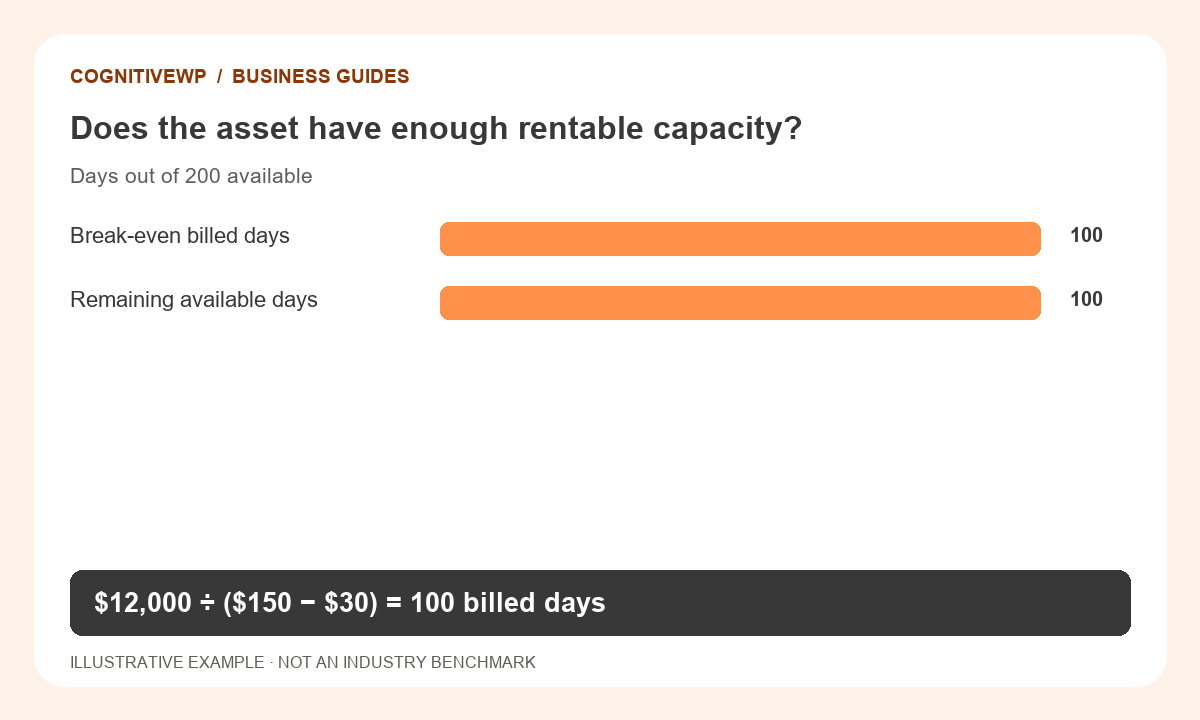
Base case: $12,000 ÷ ($150 − $30) = 100 billed days.
A $20 reduction in daily collected revenue raises the modeled requirement by 20 days. That is why a rate or discount decision should be checked against contribution rather than revenue alone.
All figures in this worked example are illustrative, not recommended prices or industry benchmarks.
Try it with your own figures
Open the Rental Equipment Utilization Calculator. Check the field definitions and use figures that match the tool’s scope.
Stress-test the rental yield and maintenance assumptions
If collected revenue falls to $130 while variable cost remains $30, contribution becomes $100 per day and break-even rises to 120 days.
At 200 available days, the required utilization rises to 60%. A seemingly small rate change can therefore materially affect the operating plan.
If revenue per day is equal to or less than variable cost, additional rental days do not recover fixed costs under this model. The break-even formula has no useful positive solution.
Review pricing, costs, or the business case rather than forcing the result into an arbitrary number.
Compare required days with realistic availability
Remove planned maintenance and other unavailable time according to your stated utilization definition. Consider seasonality, turnaround, transport, demand, and overlapping bookings.
Having 200 available days does not establish that customers will rent the asset for 100 of them.
Use the rental-equipment utilization calculator to compare observed rented days with your availability assumptions.
It measures utilization; it does not calculate this full break-even cost model. Keep billed days and physical use days aligned, especially for contracts that bill weekends differently from weekdays.
Distinguish rental-business break-even from rent-versus-buy
This article looks at an owner earning rental revenue. A customer deciding whether to rent or buy equipment faces a different comparison: expected rental spending versus the relevant costs and value of ownership over a defined horizon.
Use the equipment rent-versus-buy calculator for that separate decision and read its included costs. For the rental business case, maintain a sensitivity table with lower revenue, higher variable cost, and fewer available days.
Review results against actual collections and maintenance records rather than treating the first estimate as a forecast.
What to do next
- Use actual collections to review effective daily yield.
- Compare the required utilization with bookings and downtime.
- Use rent-versus-buy analysis only for the separate ownership decision.
Frequently asked questions
Is break-even the same as recovering the purchase price?
No. Operating break-even covers the costs included for the chosen period. Recovering an initial investment is a payback question and requires an explicitly defined cash-flow model.
Should I round the result up?
If rentals are sold only in whole days, round a fractional requirement up to the next full day. If partial-day billing applies, model that unit consistently.
Can I use calendar days for availability?
Yes, if that matches your operating and billing definition. Otherwise use the days the asset can actually be rented and label the basis.
What happens when contribution is zero?
No finite number of rental days covers positive fixed costs when each day produces zero contribution. Negative contribution makes the modeled loss larger with use.
Does the utilization calculator predict demand?
No. It calculates a ratio from your inputs. Demand, seasonality, downtime, and booking patterns need separate evidence.
Sources and further reading
The resources below support the definitions and context discussed above. The worked examples and illustrations are original CognitiveWP planning scenarios.
Related calculators and category
Find a tool for your next business decision
Compare your own costs and assumptions with free, easy-to-use business calculators.