 Find a calculator ↗
How to Price an Agency Retainer Without Underestimating Delivery Costs
A profitable agency retainer starts with a realistic delivery plan. The monthly fee needs to cover the work the client will actually receive, including coordination and revisions, rather than only the visible production tasks.
Describe the service before calculating the price
A retainer can bring predictable revenue and still be underpriced. The difference is usually in the delivery hours, coordination, and revisions that the original proposal did not allow for.
List deliverables, their frequency, the people responsible, and the work required to approve them. Define the number of revision rounds, meeting time, reporting, and support included.
A promise such as unlimited marketing help gives the cost model no clear boundary.
A practical starting checklist
- Define the monthly deliverables and revision limits.
- Estimate delivery and account-management time by role.
- Add direct costs using a consistent cost definition.
- Calculate the fee needed for your chosen margin.
- Stress-test extra work and check available team capacity.
Estimate effort by role where costs differ materially.
Strategy, design, account management, and production may have different hourly costs. Include recurring coordination that is easy to overlook, such as collecting client feedback, preparing status updates, and maintaining access to platforms.
Build a scope that can be costed
Before entering a dollar amount, turn the service promise into a delivery plan.
- Output: what will the client receive, and how often?
- Collaboration: how many meetings, reviews, and reporting tasks are included?
- Revisions: how many rounds are planned, and what counts as a new request?
- Ownership: which team member or contractor performs each activity?
- Boundaries: which expenses and services sit outside the monthly fee?
“Monthly content support” is difficult to price. “Four articles, one planning meeting, and one revision round per article” gives the estimate a usable boundary.
Use the internal cost of the people doing the work. The client billing rate is revenue, not labor expense.
Worked example: a monthly service package
| Included cost | Calculation | Amount |
|---|---|---|
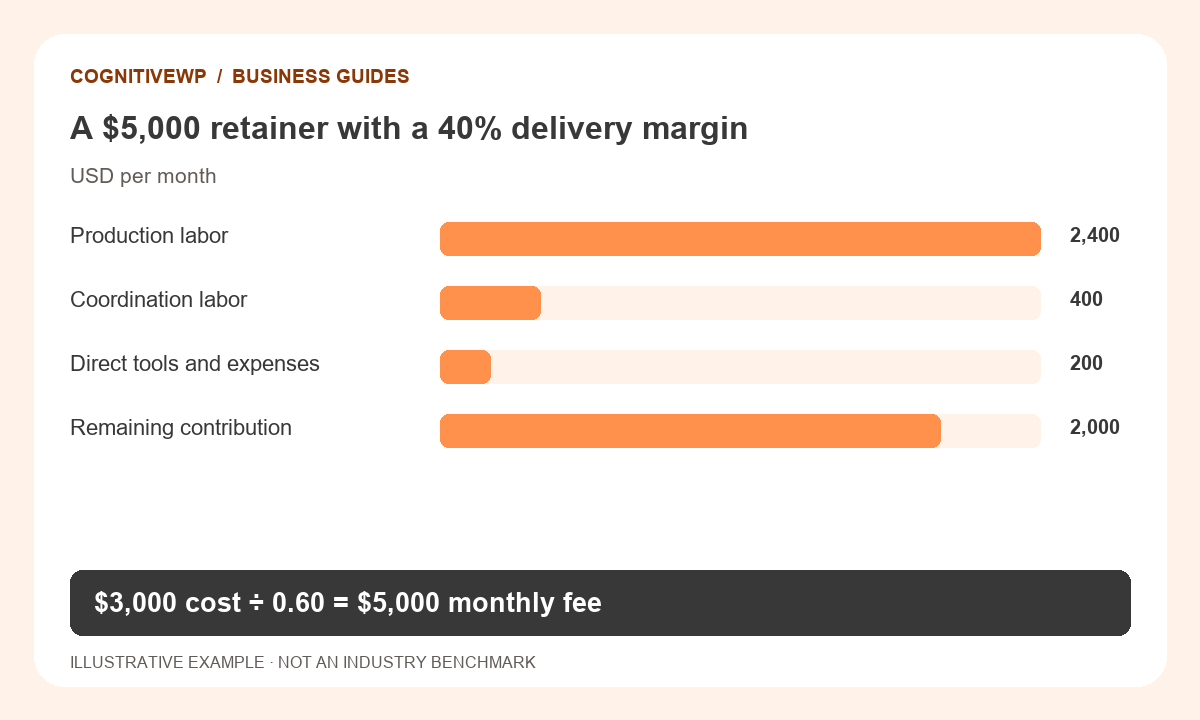
| Production | 40 hours × $60 | $2,400 |
| Coordination | 8 hours × $50 | $400 |
| Direct tools and expenses | Monthly allocation | $200 |
| Total included delivery cost | Sum of the above | $3,000 |
For a 40% margin on this cost definition:
$3,000 ÷ (1 − 0.40) = $5,000 monthly fee.
That leaves $2,000 after the included delivery costs. It is a contribution toward other business expenses and profit, not automatically the agency’s net profit.
All figures in this worked example are illustrative, not recommended prices or industry benchmarks.
Try it with your own figures
Open the Retainer Profitability Calculator. Check the field definitions and use figures that match the tool’s scope.
Stress-test scope creep before sending a proposal
If production takes 50 hours instead of 40, the extra ten hours cost $600 at the example rate. At the same $5,000 fee, included costs rise to $3,600 and the modeled delivery margin falls to 28%.
That is a meaningful change even though the client’s monthly invoice is unchanged.
Build a realistic range around uncertain tasks and state what happens when scope expands.
A change-request process, clearly priced additional work, or a planned review point can be more useful than silently absorbing extra hours. A buffer should have a reason; it is not a substitute for a defined scope.
Check the capacity behind the promise
A retainer may look attractive on paper but require specialists who are already fully committed.
Compare the monthly delivery hours with actual available capacity after internal work, leave, training, and other clients. Do not assume every paid hour is available for client delivery.
Use the billable-utilization calculator to explore capacity and the hourly-rate calculator to review the broader pricing assumptions. Keep utilization, realization, and profitability distinct: a busy team can still lose money on underpriced work.
Review actual performance at renewal
Track actual hours and direct costs by account, then compare them with the agreed scope. Discuss repeated changes in deliverables or collaboration time before they become the normal expectation.
A renewal can adjust price, scope, process, or staffing.
Check cash timing separately.
A profitable retainer can still create a cash-flow problem if payment arrives late while payroll and contractor bills are due. This article describes a pricing model, not accounting or legal advice about contract terms.
What to do next
- Compare actual hours with the agreed scope each month.
- Discuss repeated scope changes before renewal.
- Check whether higher revenue also produces a workable delivery schedule.
Frequently asked questions
Is a retainer simply an hourly fee paid in advance?
Not always. Retainers can reserve capacity or purchase a defined recurring service. The agreement should make the deliverables, availability, rollover rules, and limits clear.
Should client advertising spend be included in revenue?
Keep pass-through spend separate when assessing service economics, or clearly explain its treatment. Including it without the matching cost can exaggerate the apparent margin.
What margin should an agency target?
There is no universal target in this guide. Choose a margin that fits your cost definition, overhead needs, risk, capacity, and commercial situation. The example’s 40% is illustrative.
Can I price based on value instead of hours?
Yes, but still estimate delivery costs and capacity. A value-based proposal needs a credible commercial rationale and a scope the team can deliver.
When should I increase the fee?
Review pricing when scope, staffing costs, required capacity, or service commitments change. Use actual delivery records rather than assuming every account needs the same increase.
Related calculators and category
Find a tool for your next business decision
Compare your own costs and assumptions with free, easy-to-use business calculators.