 Find a calculator ↗
Podcast Production Cost per Episode: Build a Complete Budget
Podcast production cost per episode is the cost of taking one episode from preparation to a publishable deliverable. Recording duration alone does not capture the research, editing, review, and publishing work behind it.
Define the episode package and its deliverables
A 30-minute recording is not a 30-minute production job. Preparation, editing, approval, and publishing can account for much of the work behind the finished episode.
Specify whether the budget covers audio only or also video, a transcript, show notes, artwork, and promotional clips.
State the intended recording length, final length, guest count, and review process. A quote for a cleaned audio file cannot be compared directly with a complete video-and-social package.
A practical starting checklist
- Define the deliverables: audio, video, notes, clips, or transcript.
- Estimate preparation and recording effort.
- Budget editing and review separately.
- Add direct expenses and a stated share of recurring costs.
- Keep launch investment outside the recurring budget unless you explicitly allocate it.
Record the number of revision rounds and the delivery deadline. Guest coordination and release administration can consume time even when the recording goes smoothly.
Assign that work explicitly instead of assuming the editor or host will absorb it at no cost.
Turn the episode package into a production brief
A clear brief makes provider quotes and internal budgets easier to compare.
- Format: solo, interview, or several speakers; audio only or video.
- Source material: expected recording length and recording quality.
- Finished output: final episode, notes, artwork, transcript, and clips.
- Review: who approves the episode and how many rounds are included.
- Delivery: deadlines, file formats, and who handles publishing.
An editor quoting a cleaned audio file may not be quoting guest coordination, show notes, or promotional video. Confirm exclusions before deciding which quote is cheaper.
Treat uncertain recording quality as a budget risk. Software cannot reliably repair every source-audio problem.
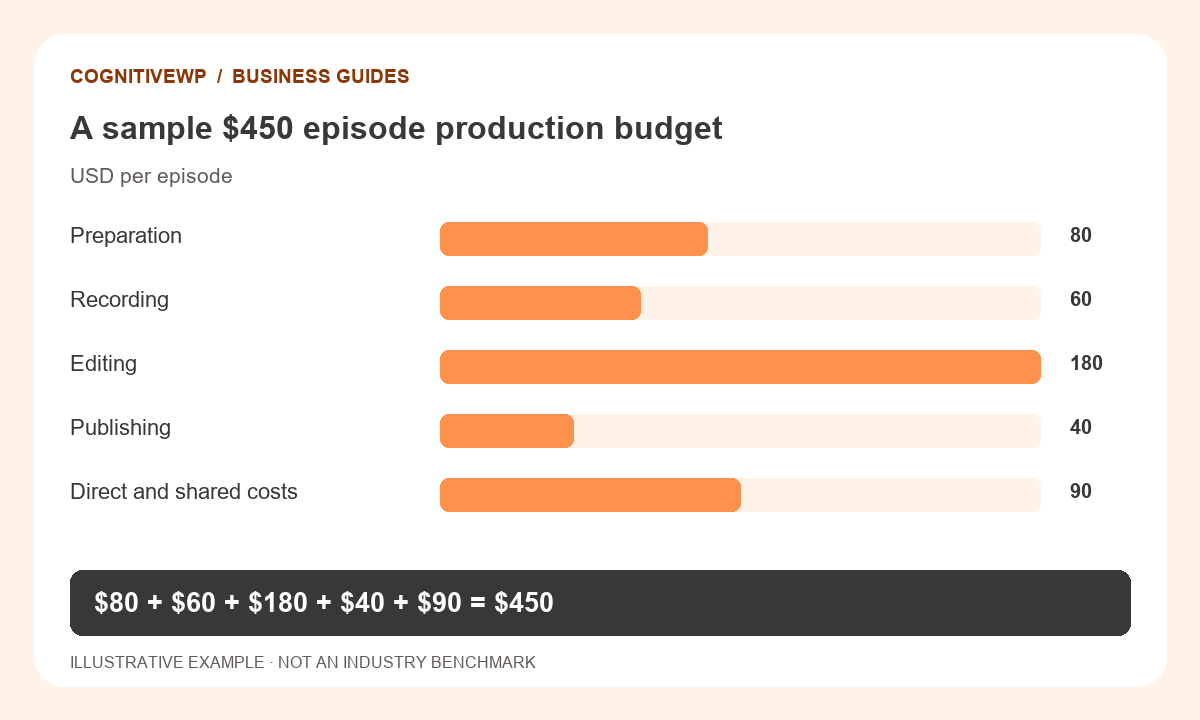
Worked example: one audio episode
| Production stage | Illustrative cost |
|---|---|
| Preparation | $80 |
| Recording labor | $60 |
| Editing: 3 hours × $60 | $180 |
| Publishing | $40 |
| Direct and allocated shared expenses | $90 |
| Total | $450 |
The package costs $450 under these assumptions.
If editing requires two additional hours at $60, the total becomes $570. Repeated overruns suggest that the scope or effort estimate needs revision.
All figures in this worked example are illustrative, not recommended prices or industry benchmarks.
Try it with your own figures
Open the Podcast Episode Cost Calculator. Check the field definitions and use figures that match the tool’s scope.
Allocate equipment and subscriptions without duplication
A microphone purchase is an upfront cash expense, but allocating its entire cost to every episode would exaggerate recurring episode cost.
Keep launch investment and ongoing production spending separate. If you assign equipment cost across planned episodes, state the number and treat it as a planning allocation, not tax depreciation advice.
Similarly, split a shared hosting or editing subscription across the episodes or other uses it supports. If a production vendor’s fee already includes its software and equipment, do not add those same costs again unless your business is separately paying them.
Model editing uncertainty and revision work
Long interviews, multiple speakers, inconsistent audio, and detailed approval processes can affect editing effort. Instead of assuming one universal editing multiplier, model a normal case and a more demanding case using your own production records or a vendor’s defined scope.
For example, two extra editing hours at $60 add $120 to the sample budget, bringing the episode to $570.
If the increase repeats every week, it is a recurring scope issue rather than a one-off overrun. Decide whether to improve preparation, simplify the deliverable, or adjust the budget.
Connect episode cost to the publishing schedule
A four-episode production plan at $450 each gives $1,800 for the included episode work.
Add any launch or campaign costs that sit outside that package. Use the actual release plan rather than assuming every calendar month always contains the same number of weekly episodes.
Cost and capacity are separate. An affordable episode can still miss its release date when the editing queue grows faster than the team clears it.
Use the podcast backlog calculator to compare incoming work with completed episodes and to understand whether the queue can shrink under your assumptions.
What to do next
- Track actual editing and revision time by episode type.
- Compare quotes using the same deliverables and approval rounds.
- Check the editing backlog as well as the cost per episode.
Frequently asked questions
Is production cost the same as an editor’s fee?
No. Editing is one stage. Preparation, recording, coordination, publishing, and shared costs may sit outside an editor’s quote.
Should the host’s time be included?
Include it when estimating total resources used. You can show unpaid founder time separately from cash expenses so the budget answers both questions clearly.
Does a 30-minute episode take 30 minutes to edit?
Not necessarily. Review, structural changes, repairs, and revisions can take longer. Use observed effort for comparable work instead of assuming a fixed ratio.
Should launch equipment be charged to the first episode?
Show upfront cash spending separately. For an ongoing unit-cost model, document any allocation across expected episodes and do not confuse it with tax treatment.
How can I compare vendor quotes fairly?
Use the same deliverables, source-audio assumptions, turnaround, revision rounds, and file requirements. Check what each quote excludes before comparing the price.
Sources and further reading
The resources below support the definitions and context discussed above. The worked examples and illustrations are original CognitiveWP planning scenarios.
Related calculators and category
Find a tool for your next business decision
Compare your own costs and assumptions with free, easy-to-use business calculators.