 Find a calculator ↗
Billable Utilization Rate: Calculate Capacity Without Hiding Nonbillable Work
Billable utilization measures how much of your available working time goes to billable client work. The calculation is simple. Choosing the right hours—and understanding what the percentage leaves out—takes more care.
Start with a consistent definition
A consultant can be busy all week and still record relatively few billable hours. Proposals, team management, training, and internal administration all take time. Calling every occupied hour billable would hide that difference.
Decide what counts as billable under your contracts. On a fixed-fee project, client delivery time can still be classified as billable for capacity tracking even though the invoice is not calculated by the hour. Keep that classification consistent across projects.
Utilization describes time allocation, not cash collected. An hour can qualify as client delivery time and still be written off, discounted, or included in an unprofitable project.
Build the denominator before setting a target
- Choose the reporting period and people included.
- Add their scheduled hours for that period.
- Subtract leave and holidays only if those hours were included in the schedule.
- Add billable hours from the same people and dates.
- Divide billable hours by available hours and multiply by 100.
Do not subtract the same holiday twice. If your schedule already contains only working days, removing holiday hours again artificially raises utilization.
Internal meetings normally remain within available time under this definition. Removing them from the denominator makes the percentage answer a different question. If you use another definition, label it and avoid comparing it directly with this calculation.
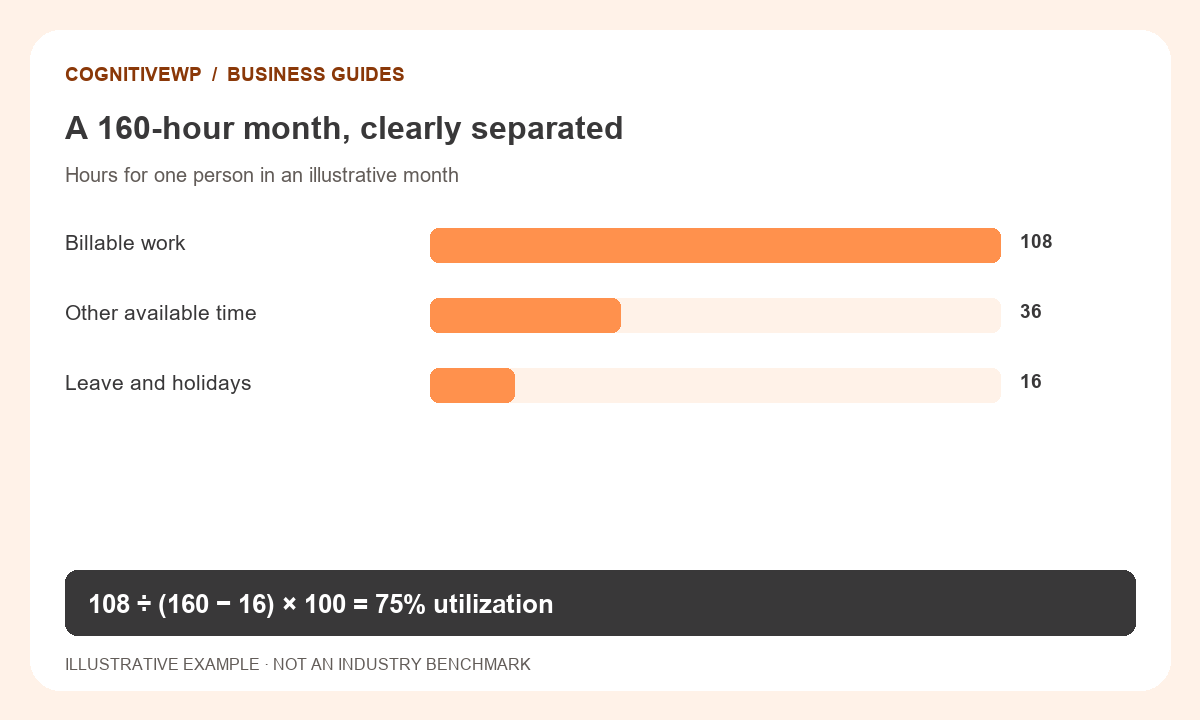
Worked example: one consultant, one month
| Input or result | Hours |
|---|---|
| Scheduled hours | 160 |
| Leave and holidays included above | 16 |
| Available hours | 144 |
| Billable hours | 108 |
| Available nonbillable hours | 36 |
The utilization rate is 108 ÷ 144 × 100 = 75%. The 36 remaining available hours are not automatically waste. They may include sales work, required administration, or valuable learning.
If the planning target is 80%, target billable hours are 144 × 0.80 = 115.2 hours. The gap is 7.2 hours. Before filling that gap, check whether suitable client work exists and whether the person has the right skills.
Calculate team utilization from totals
For a team, add billable hours and available hours before dividing. A simple average of individual percentages can mislead when people have different schedules.
Suppose one person bills 108 of 144 available hours and another bills 48 of 96. Team utilization is 156 ÷ 240 = 65%. Averaging their individual rates of 75% and 50% gives 62.5%, which incorrectly gives equal weight to unequal available hours.
Keep separate views by role when useful. A manager with sales and supervision responsibilities should not automatically have the same delivery-time target as a specialist assigned mainly to client work.
Use the result without chasing a perfect score
There is no universal target that fits every service business. A useful target reflects the work you sell, the support activities each role performs, and the capacity you want to reserve for unexpected demand.
- Compare like periods using the same hour definitions.
- Review project margin and write-offs alongside utilization.
- Investigate sustained overtime instead of treating it as spare capacity.
- Check whether low utilization reflects a sales gap, a skill mismatch, or incomplete time records.
A very high percentage may leave little room for planning, quality checks, or future sales. A lower percentage can be reasonable during onboarding or deliberate investment in a new service. Use the number to ask better questions before changing staffing.
A practical diagnosis: busy people, weak project results
A high utilization rate can coexist with disappointing project results. Before raising the target, separate three questions: are hours recorded correctly, is work priced appropriately, and is delivery staying within the agreed scope?
Check the records first
Compare the time report with the people and dates in your schedule. Look for missing entries, overtime, and client work recorded as administration. Correct the classification before drawing a staffing conclusion.
Next, compare planned delivery hours with actual hours. If a project was priced for 40 hours but requires 60, the team can be fully occupied while the effective return per hour falls. Increasing utilization will not repair that pricing gap.
Then examine the work mix
Suppose two consultants each record 100 billable hours. One delivers work within the agreed budget; the other spends 25 hours on unpriced revisions. Their utilization percentages can look similar even though their project economics differ.
This is why utilization belongs beside a scope and profitability review. Use the percentage to understand capacity, then investigate what the capacity is producing.
- If time records are incomplete, improve recording before changing targets.
- If low utilization follows a shortage of suitable assignments, review demand and scheduling.
- If utilization is high but margins are weak, inspect pricing, revisions, and delivery estimates.
- If overtime is persistent, compare the workload with sustainable available hours.
Choose a target by responsibility
Start with the work each role must do. A delivery specialist, a team lead, and a founder have different responsibilities outside client work. Reserve time for those responsibilities before choosing a billable target.
Review the target over several comparable periods. One unusually quiet week or a project launch does not establish a lasting capacity problem. Record why the target changes so future comparisons remain meaningful.
Frequently asked questions
Should vacation be included in available hours?
In this guide, subtract vacation and holidays that were included in scheduled hours. If the starting schedule already excludes them, do not subtract them again.
Is billable utilization the same as productivity?
No. Utilization measures the share of available hours assigned to billable work. It does not measure quality, speed, client outcomes, or profit.
Can utilization exceed 100%?
It can appear above 100% if billable overtime is compared with a schedule that excludes those hours. Check the periods and definitions before interpreting the result.
How do I include part-time staff?
Use each person’s actual scheduled hours, subtract relevant leave, and calculate the team rate from combined billable and available hours.
What is a good utilization target?
Choose a target that leaves time for the responsibilities of each role. Your own service model and historical data are more useful than an unexplained universal percentage.
Related calculators and category
Find a tool for your next business decision
Explore free calculators to compare costs, capacity, and planning assumptions.