 Find a calculator ↗
Freight Cost per Unit: Allocate a Shipment Without Distorting Product Costs
Freight cost per unit spreads the transport cost of a shipment across the units it contains. It is a useful planning measure when units are comparable. Mixed shipments need more care because a small item and a bulky item may not use the same transport capacity.
Choose the shipment and cost scope
Start with a single shipment or a clearly defined group of similar shipments. Decide whether you are measuring inbound freight, outbound delivery, or another transport leg.
Use charges that belong to that shipment. A base quote may exclude fuel, handling, insurance, or accessorial services. Review the final invoice when available rather than assuming the quoted base rate is the full cost.
Freight cost is not automatically landed product cost. Product purchase cost, duties, and other relevant charges may belong in a broader landed-cost calculation. Keep those additional categories distinct.
Choose a denominator that makes sense
| Basis | Useful when | Watch for |
|---|---|---|
| Unit count | Items are reasonably comparable | Large differences in size or weight. |
| Weight | Weight is a meaningful driver of the charge | Bulky low-density products. |
| Volume | Space is a meaningful driver | Weight limits or special handling. |
| Direct assignment | A charge clearly belongs to one item group | Allocating it again to the whole shipment. |
The linked calculator uses unit count. It does not choose the best allocation method for a mixed load. If your shipment contains different products, document the method before comparing per-product costs.
The best planning allocation depends on what drives the charge and the question you are answering. Consistency matters, but a consistently inappropriate basis can still distort decisions.
Worked example: a comparable-unit shipment
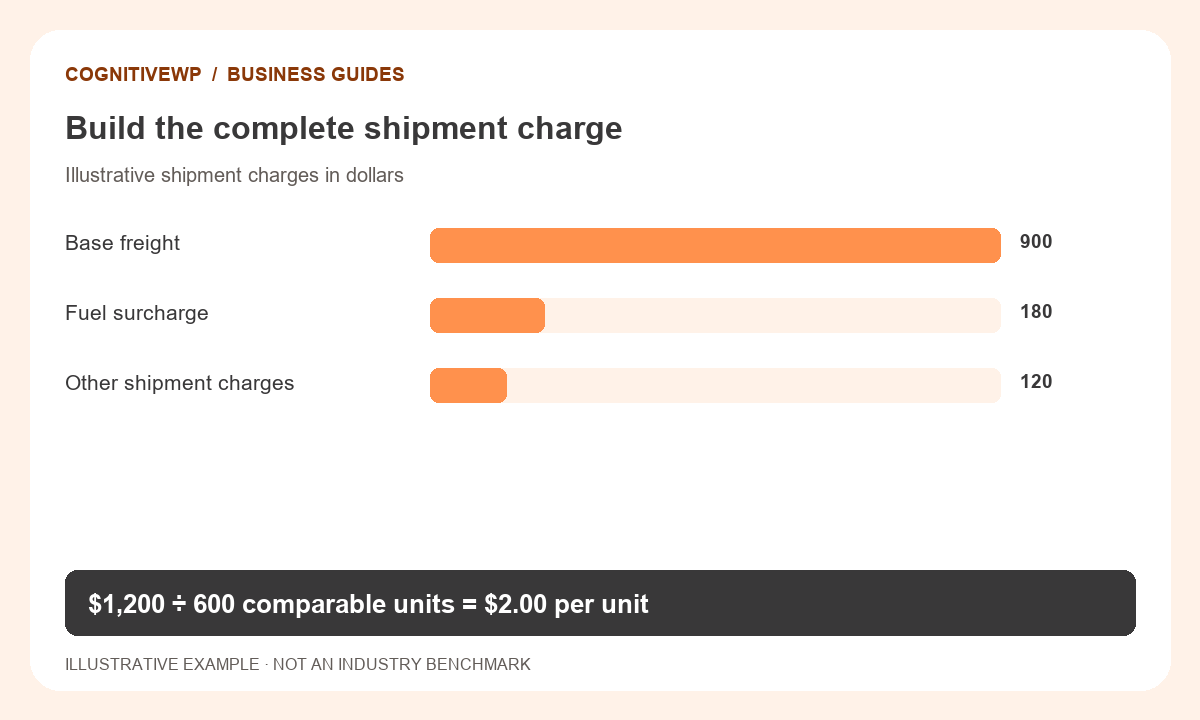
Assume base freight is $900, fuel surcharge is $180, and other shipment charges total $120. The shipment contains 600 comparable units.
Total freight is $1,200. Freight per unit is $2.00.
If the same total charge applied to only 400 units, the average would be $3.00 per unit. That illustrates how spreading a fixed shipment charge over fewer units raises the average. It does not prove the carrier would quote the same total for a different load.
Enter a fuel surcharge as a dollar amount in the calculator. If the invoice instead states a percentage, first apply it to the carrier’s specified charge basis. A 20% surcharge is not entered as $20 unless that is the actual dollar charge.
Handle mixed loads and damaged units carefully
Suppose a mixed shipment has 100 heavy units weighing 4 kg each and 100 lighter units weighing 1 kg each. A $1,000 freight bill allocated by weight assigns $800 to the heavy group and $200 to the light group: $8 and $2 per unit respectively.
A simple count allocation would assign $5 to every unit. Neither calculation changes the total invoice; they distribute it differently. Use a basis that suits the freight arrangement and your cost question.
If 600 units were shipped but only 590 are usable, freight per shipped unit remains $2.00 in the first example. Allocating the same freight to usable units gives about $2.03. Label that different denominator and handle damage claims or recoveries separately.
Turn a unit cost into a useful comparison
- Compare shipments with the same cost scope and service level.
- Separate final invoice costs from unconfirmed estimates.
- Check whether larger orders create extra storage or holding costs.
- Review delivery reliability and damage alongside price.
- Use unrounded totals for the calculation, then round the displayed result.
A lower freight average may come with longer lead times or more inventory. Evaluate the full operating trade-off before changing order sizes solely to reduce the per-unit figure.
From quote to final invoice: reconcile the difference before comparing shipments
A freight estimate can change after the shipment is completed. Keep the quoted amount and the final invoiced amount as separate fields so a cost comparison does not mix estimates with settled charges.
For each difference, record what changed: shipment quantity, the charge basis, a requested service, or another invoiced item. Use the carrier’s actual description and terms rather than assuming every extra charge has the same cause.
A small reconciliation example
Suppose a quote totals $1,080 for 600 units. The final invoice totals $1,200 for those same units. The estimate was $1.80 per unit; the final cost is $2.00. The difference is $120 per shipment, or $0.20 per unit.
If only 500 units actually shipped, the final average becomes $2.40. Separate the invoice increase from the quantity change: both affect the unit figure, but they require different explanations.
Use a repeatable comparison sheet
Record the shipment, service level, units, base charge, fuel charge, other charges, and whether each amount is quoted or final. Add the allocation basis for mixed products. This makes the result traceable when another team member reviews it later.
When comparing carriers, align what the quotes include. A lower visible base price is not a complete comparison if another quote includes services that will be charged separately.
Watch the trade-off with inventory
Combining orders can spread shipment costs over more units, but it may also keep products in storage longer. Compare any freight reduction with the extra inventory investment and the expected holding period.
Do not assume the full allocated warehouse cost becomes an extra cash expense for a small order change. Identify which costs actually move with the decision. The same discipline applies when estimating savings from a larger shipment.
Finish the review with a clear statement: cost per comparable shipped unit, for a defined service and cost scope, using either an estimate or a final invoice. That sentence is more useful than a bare number on a dashboard.
Frequently asked questions
Should fuel surcharges be included?
Include relevant fuel charges when measuring full shipment freight. Enter the dollar charge, not the percentage printed on a quote.
Can I divide by cartons instead of products?
Yes, if you want freight per carton. Use a clear label and do not compare it directly with a per-product measure.
Is freight per unit the same as landed cost?
No. Landed cost may include product cost and other charges beyond transport. Define the scope before combining the figures.
What if there are no units in the shipment?
The per-unit calculation is undefined with a zero denominator. Check the shipment quantity before interpreting the result.
Does a larger shipment always reduce the unit cost?
No. Rates, capacity limits, service levels, and additional charges can change. Compare actual quotes and the related inventory costs.
Related calculators and category
Find a tool for your next business decision
Explore free calculators to compare costs, capacity, and planning assumptions.