 Find a calculator ↗
How to Calculate Packaging Cost per Unit: Materials, Labor, and Waste
Packaging cost per unit is the cost of preparing one usable product or shipment for delivery. A useful estimate includes more than the box: materials, packing labor, setup charges, and waste all affect the amount you spend.
Define what you are costing
A box price is not a packaging budget. The useful number is the cost of getting one usable, packed unit ready for the next step.
Start with one specific packaging configuration.
A single-item shipment might need one carton, one label, tape, and cushioning. A wholesale case may contain several retail units plus one outer carton. Build separate estimates for these formats instead of assigning every product the same packaging charge.
A practical starting checklist
- Choose one pack format: a retail unit, shipping carton, or customer order.
- List the materials that format actually consumes.
- Measure packing time on a representative batch.
- Include setup and freight once, using a documented allocation.
- Divide by good output, not by the number of attempts.
Write down whether the result is per sellable item, inner pack, shipping carton, or order. If an order contains four items, the outer shipping box belongs to the order; charging the full box cost to every item would overstate the total.
Use a consistent allocation method when an order contains products of different sizes.
Build the cost sheet from the inside out
Start with the materials that touch one product. Then add anything shared by the order or batch. This prevents an outer carton from being charged to every item inside it.
| Cost line | How to estimate it | Check before adding it |
|---|---|---|
| Cartons, labels, tape, filler | Quantity used × cost per usable component | Convert case or roll prices into the correct unit. |
| Packing labor | Packing minutes ÷ 60 × hourly labor cost | Include only time assigned to the packing scope. |
| Setup or printing | Batch setup charge ÷ good units | Do not treat a one-time fee as a recurring fee per item. |
| Inbound freight | Assigned freight ÷ good units | Check whether the supplier price already includes it. |
For example, a $60 case containing 100 usable cartons has a component cost of $0.60 per carton. If some arrive unusable, the effective cost per usable carton increases.
Keep outbound delivery separate unless you deliberately want a combined fulfillment cost.
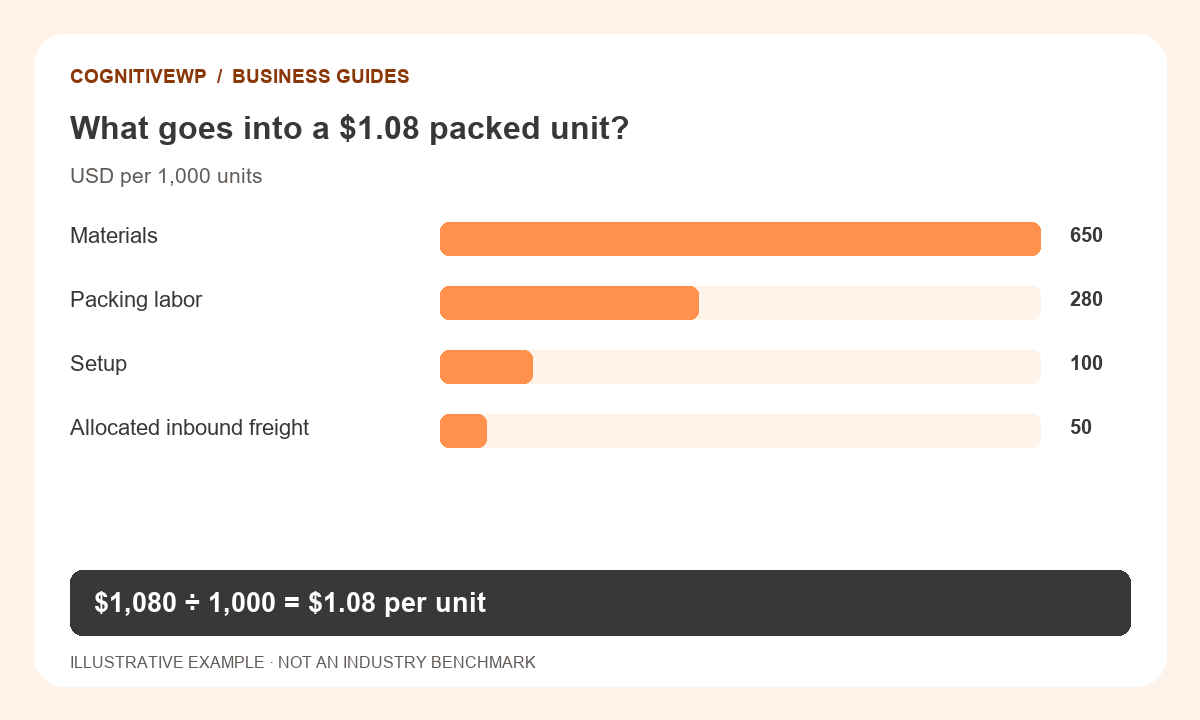
Worked example: a 1,000-unit batch
| Cost item | Batch cost | Per usable unit |
|---|---|---|
| Materials | $650 | $0.65 |
| Packing labor: 10 hours × $28 | $280 | $0.28 |
| Setup | $100 | $0.10 |
| Allocated inbound freight | $50 | $0.05 |
| Total | $1,080 | $1.08 |
$1,080 ÷ 1,000 = $1.08 per usable unit.
The labor line uses observed time for the whole batch. Setup and freight are assigned once. Replace these sample figures with your own supplier quotes and production records.
All figures in this worked example are illustrative, not recommended prices or industry benchmarks.
Try it with your own figures
Open the Packaging Cost per Unit Calculator. Check the field definitions and use figures that match the tool’s scope.
Account for waste without counting it twice
If $650 is the actual material spend for the completed batch, and that spend already includes damaged cartons and discarded labels, do not add another waste percentage to the same costs. If you are forecasting from perfect-use component quantities, estimate the extra material needed to achieve the required good output.
A 5% reject rate means good output is 95% of attempted output. 95, or about 1,053 attempts.
Adding 5% produces 1,050 attempts, which uses a different convention. State which convention your spreadsheet or supplier uses.
Compare changes using total cost, not box price alone
A cheaper carton can increase packing time, filler use, storage space, or damage. Compare the complete current and proposed configurations at the same output quantity.
16, so the modeled packaging cost rises.
Test the proposed pack before committing to a large order.
Record labor time, good output, and damage separately. A cost model cannot prove a design will protect the product; material specifications, carrier requirements, and real transit conditions still matter.
Use the result in pricing and purchasing
Multiply the unit cost by your expected volume to create a packaging budget, then separate one-time setup spending from recurring costs. A setup fee spread over 1,000 units will produce a different unit cost when the same fee is spread over 5,000 units.
Before comparing suppliers, reconcile order quantities, freight, printing, taxes where applicable, and payment terms. Record the quote date and specification.
Review the model when a component price, pack design, labor process, or order mix changes rather than assuming last year’s unit cost still applies.
What to do next
- Compare the current and proposed pack at the same batch size.
- Check packing time, protection, and waste—not just material price.
- Record the quote date and specification beside each assumption.
Frequently asked questions
Does packaging cost include shipping?
It can, but it usually helps to show packaging and outbound shipping separately. This guide includes assigned packaging inputs and labels inbound freight explicitly. Add delivery costs only when you intend to report a broader fulfillment measure.
Should I divide by produced units or usable units?
Use usable packed units when the question is what each good unit costs. Include the costs consumed by rejects in the numerator, while keeping rejected output out of the good-unit denominator.
How should I treat reusable packaging?
Estimate cost per expected use, including cleaning, returns, losses, and maintenance. Track actual reuse because the planned number of cycles may not be achieved.
Is the lowest cost per unit always the best option?
No. Protection, handling, customer requirements, storage, and damage exposure also matter. Compare the cost and performance of a defined packaging system.
How often should the calculation be updated?
Update it when quotes, wages, packaging specifications, batch sizes, or waste rates change. Reconcile a forecast against actual spending after a representative production run.
Related calculators and category
Find a tool for your next business decision
Compare your own costs and assumptions with free, easy-to-use business calculators.