 Find a calculator ↗
Inventory Record Accuracy: Exact Matches vs. Quantity Variance
Inventory record accuracy measures how reliably stock records agree with a physical count under a defined matching rule. Exact-match accuracy and quantity variance reveal different kinds of problems, so they should not be treated as interchangeable percentages.
Define the inventory record you are testing
A record can be wrong by one unit or by a hundred. Exact-match accuracy treats both as a mismatch; quantity variance tells you how large the errors are.
A record may be a SKU in a particular location, and it may also include lot, serial, or condition information. Counting by SKU across an entire warehouse can hide stock stored in the wrong location.
Choose the level that matches the operational question.
A practical starting checklist
- Define a record, such as one SKU at one location.
- Use a controlled count and matching system snapshot.
- State whether the rule requires an exact match or allows tolerance.
- Count matching records and total checked records.
- Review the size and causes of discrepancies separately.
Specify what makes a record correct.
An exact quantity match is different from a match within a tolerance, and matching quantity does not necessarily confirm the lot or condition. Label a tolerance-based measure as such rather than calling it exact-match accuracy.
Choose the measure before interpreting the percentage
| Measure | What it shows | What it does not show |
|---|---|---|
| Exact-match record accuracy | Share of checked records that match exactly | The number or value of units involved in mismatches. |
| Signed quantity variance | Net overage or shortage | Total error size when overages and shortages cancel. |
| Absolute quantity variance | Total magnitude of unit differences | A universal accuracy percentage without a defined denominator. |
Suppose one record is ten units over and another is ten units short. Net variance is zero, but there are still 20 units of absolute discrepancy.
Zero net variance does not mean every record is correct.
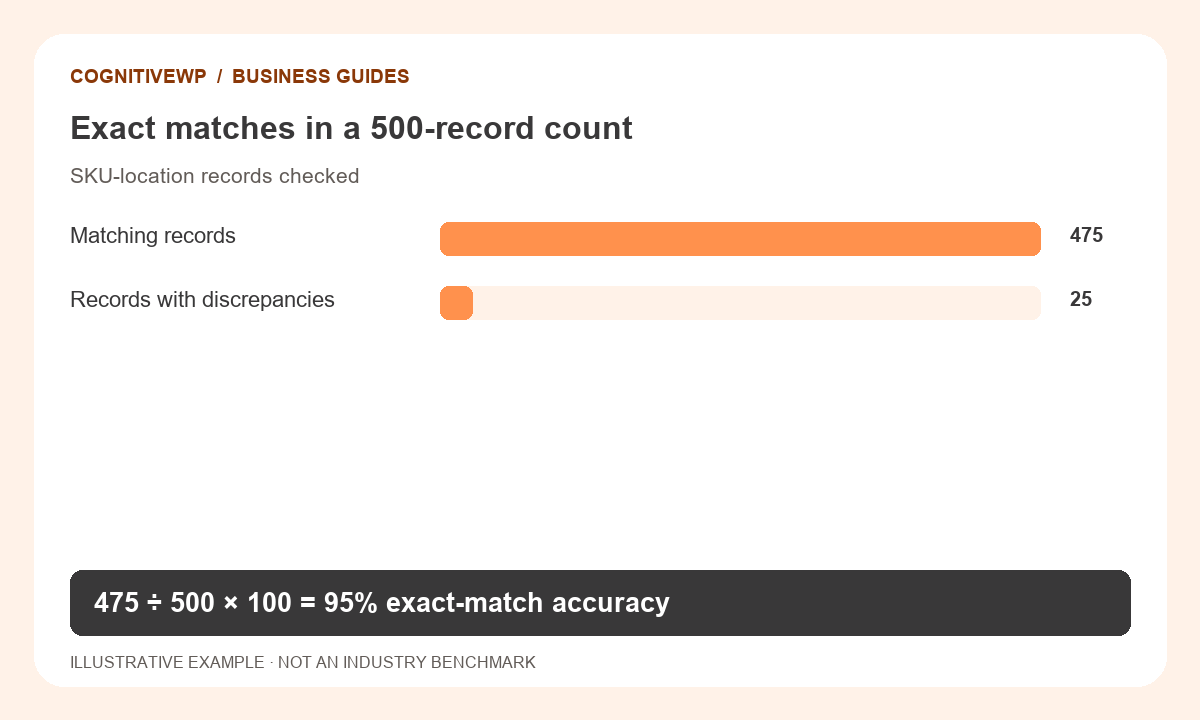
Worked example: 475 matching records
| Count result | Records |
|---|---|
| Exact matches | 475 |
| Records with a discrepancy | 25 |
| Total checked | 500 |
475 ÷ 500 × 100 = 95% exact-match accuracy.
The remaining 5% of checked records did not match. This tells you how often records were correct, not whether 95% of inventory units or dollars were correct.
All figures in this worked example are illustrative, not recommended prices or industry benchmarks.
Try it with your own figures
Open the Inventory Count Accuracy Calculator. Check the field definitions and use figures that match the tool’s scope.
Use quantity variance to see the size of errors
Exact-match accuracy treats a one-unit mismatch and a 100-unit mismatch as two incorrect records. That is useful for record reliability but does not describe the severity of the differences.
Add a separate quantity or value view when the size of errors matters.
For example, two checked records might be ten units over and ten units short.
Signed net variance is zero, but absolute variance is 20 units. Calculate absolute differences before adding them when you want to measure total mismatch. Do not cancel shortages against overages and call the combined stock accurate.
Keep samples and comparisons meaningful
Document how records are selected.
Random sampling, full counts, and targeted cycle counts support different interpretations. A targeted review of known problem locations can produce a lower match rate even while the overall inventory process improves.
Compare periods with the same record definition, matching rule, selection approach, and timing controls. When the method changes, explain the change beside the result.
Record both matches and total records so a percentage can be traced back to the count.
Turn discrepancies into corrective action
Recount unusual differences and check transaction timing before adjusting records. Investigate likely causes such as receiving errors, incorrect location transfers, unit conversions, unrecorded damage, or picking mistakes.
Correcting the quantity alone may leave the underlying process problem untouched.
Use the count-accuracy calculator for the exact-match percentage and the cycle-count labor planner to estimate the workload for a defined counting program.
The labor plan does not establish sampling validity or authorize stock adjustments. Follow your business’s count controls and review process.
What to do next
- Reconcile transaction timing before changing stock records.
- Investigate unit conversions, transfers, receiving, and picking errors.
- Use a consistent count method when comparing periods.
Frequently asked questions
Is 95% record accuracy the same as 95% quantity accuracy?
No. Record accuracy counts matching records. Quantity measures examine the size of differences under a separate formula and denominator.
Can overages and shortages cancel each other?
They can cancel in signed net variance, but that does not remove the underlying errors. Sum absolute differences when measuring the total size of mismatches.
Should a small tolerance count as an exact match?
No. If you allow a tolerance, describe the result as tolerance-based accuracy and state the threshold. Keep it separate from exact matching.
What if no records were checked?
There is no meaningful accuracy percentage. Report no records checked rather than interpreting the period as perfect or failed accuracy.
Does a cycle count represent the whole warehouse?
Only to the extent supported by its selection and sampling method. Targeted counts of risky items should not automatically be generalized to every inventory record.
Sources and further reading
The resources below support the definitions and context discussed above. The worked examples and illustrations are original CognitiveWP planning scenarios.
Related calculators and category
Find a tool for your next business decision
Compare your own costs and assumptions with free, easy-to-use business calculators.