 Find a calculator ↗
Training Cost per Employee: What to Include and How to Calculate It
Training cost per employee helps you budget a learning program and explain the resources it requires. The result depends on whether you count only direct expenditure or also include the value of employees’ paid learning time.
Choose the question your training budget should answer
A course invoice tells you what you paid the provider. It does not necessarily tell you what the training program used in total resources.
For a specific workshop, cost per participant usually provides a useful planning unit. For an organization-wide learning budget, you might divide annual expenditure by average employee headcount.
These denominators answer different questions and should not share an unlabeled figure.
A practical starting checklist
- Choose cost per participant, employee, or completion.
- List direct program spending.
- Decide whether to include paid learning and internal delivery time.
- Allocate shared expenses once.
- Report the cost definition alongside the result.
If you want to understand successful completion, use completions as a separate denominator and define what completion requires.
A person registering for a course, attending one session, and passing an assessment represent different stages. Track these counts before deciding which result to report.
Separate the three questions people call training cost
| Measure | Denominator | Best used for |
|---|---|---|
| Cost per participant | People participating in the program | Budgeting a particular workshop or course. |
| Expenditure per employee | Defined company headcount | Reviewing an organization-wide learning budget. |
| Cost per completion | People meeting the completion rule | Understanding the resources used per completed outcome. |
A registration, an attendance record, and a successful completion are not the same event. Keep those counts separate.
Next, distinguish cash spending from paid employee time. Salaried employees may spend valuable time in training without creating an additional payroll payment for that session.
Worked example: a four-hour workshop
| Cost | Calculation | Amount |
|---|---|---|
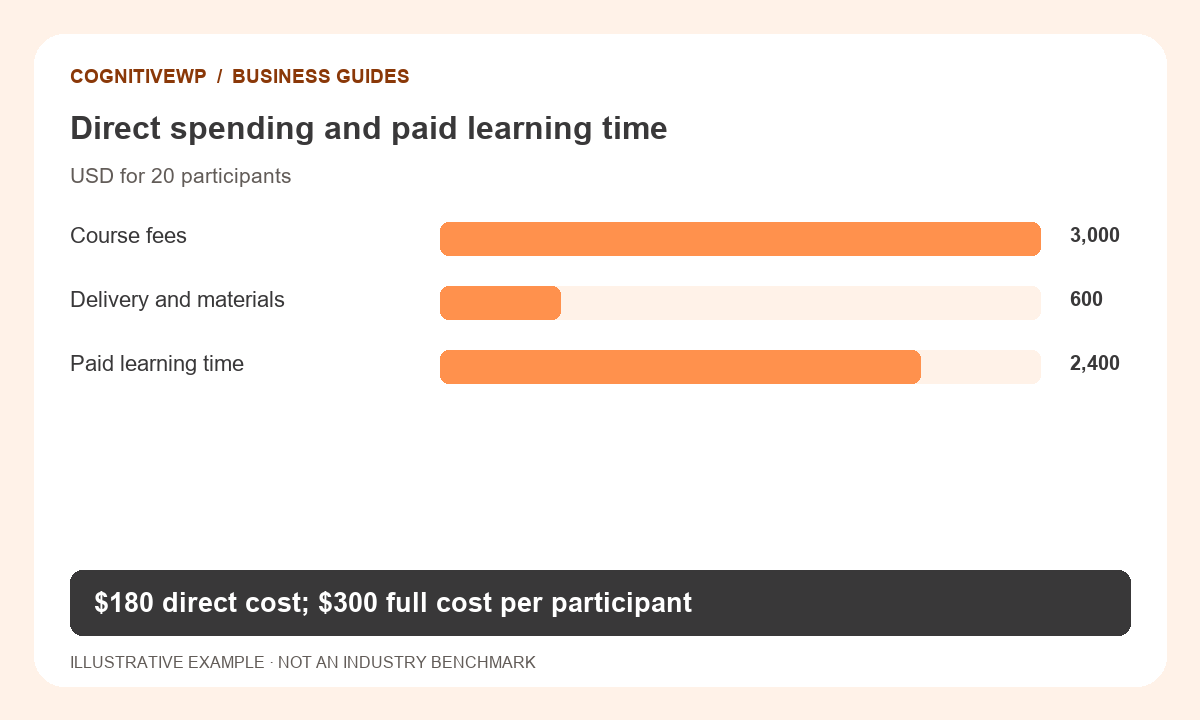
| Course fees | Program fee | $3,000 |
| Delivery and materials | Program spending | $600 |
| Direct spending | Fees + delivery | $3,600 |
| Paid learning time | 20 × 4 hours × $30 | $2,400 |
| Full modeled resource cost | $3,600 + $2,400 | $6,000 |
Direct cost per participant: $180.
Full modeled cost per participant: $300.
The figures differ because they include different resources. Neither should be compared with an external benchmark until the cost and headcount definitions match.
All figures in this worked example are illustrative, not recommended prices or industry benchmarks.
Try it with your own figures
Open the Employee Training Cost Calculator. Check the field definitions and use figures that match the tool’s scope.
Treat shared costs consistently
If an annual platform supports multiple programs, allocate a reasonable share rather than assigning its full subscription to every course. For reusable content, distinguish the initial development cost from the marginal cost of another session.
Keep the allocation rule visible in the budget.
Avoid counting instructor time twice when it is already included in a vendor fee.
Likewise, check whether your employee hourly cost already contains benefits or overhead before adding another allowance. A reconciliation back to invoices and payroll assumptions helps catch overlapping cost lines.
Model attendance and completion separately
If only 16 employees attend while the $3,600 direct commitment stays fixed, direct cost per attendee rises to $225. Paid learning time would depend on the actual attendance hours; do not keep a 20-person time estimate and label it an actual 16-person result.
A low attendance rate may suggest a scheduling problem, while low completion could signal workload, course design, or support needs. The training-session capacity calculator helps check seating or delivery capacity, but capacity does not prove attendance or learning outcomes.
Connect cost to outcomes without claiming automatic ROI
Use cost alongside a relevant outcome measure, such as completion, demonstrated skill, or a carefully defined operational change. Lower cost per participant does not necessarily mean better training, and a more expensive program may address a different need.
Return on investment requires a credible estimate of benefits and a defensible way to connect them to the training.
A cost calculator cannot establish that connection. Start with a stated objective, record the assumptions, and compare the actual program costs and outcomes after delivery.
What to do next
- Record participation and completion separately.
- Reconcile direct costs against invoices.
- Review skill or operational outcomes before calling a low-cost program successful.
Frequently asked questions
Should salaried employee time be included?
Include it when estimating total resources used, but show it separately from incremental cash spending. A salaried person’s time has value even if the workshop does not change payroll.
Should I divide by all employees or trainees?
Use all employees for an organization-wide expenditure-per-employee measure. Use participants for a specific program. Label the denominator so readers can compare like with like.
How should reusable course development be treated?
Show the initial investment separately, then allocate it across an explicitly stated number of sessions or learners for planning. Revisit that allocation if usage changes.
Does a lower cost per completion prove success?
No. It describes efficiency on a defined basis. Learning quality, application, and the business objective still need their own measures.
What if the course has no participants?
Per-participant cost cannot be calculated with a zero denominator. Report committed costs and explain that no participants were served.
Sources and further reading
The resources below support the definitions and context discussed above. The worked examples and illustrations are original CognitiveWP planning scenarios.
Related calculators and category
Find a tool for your next business decision
Compare your own costs and assumptions with free, easy-to-use business calculators.