 Find a calculator ↗
Recurring Meeting Cost: Calculate Participant Time, Preparation, and Annual Effort
Meeting cost puts a value on the participant time used by a meeting, including preparation and follow-up. It helps compare meeting designs, but it does not tell you whether a meeting is worthwhile or how much cash you will save by canceling it.
Count participant-hours, not just calendar hours
A one-hour meeting with six people uses six participant-hours. That is different from saying the meeting takes one hour. Preparation and follow-up add more effort outside the calendar slot.
Use the participants who actually need to attend. If some people join only for part of the meeting, either calculate their time separately or use an appropriately weighted estimate.
The calculator assumes all entered attendees participate for the entered duration and use the same average preparation time. A detailed attendance sheet is better when those differences are large.
Choose a defensible hourly cost
Use a loaded hourly labor cost consistent with your planning approach. That may include salary and relevant employer costs. It is not the rate you would charge a customer for the same person’s work.
When attendees have different hourly costs, use an attendance-weighted average or calculate each person’s time cost and add the results. A senior participant who attends briefly should not be treated as present for the entire meeting.
- Keep the wage or cost period consistent.
- Include preparation and follow-up once.
- Use expected actual occurrences rather than assuming every week is identical.
- Record the assumptions so someone else can reproduce the estimate.
Worked example: a weekly six-person meeting
| Input | Value |
|---|---|
| Attendees | 6 |
| Meeting duration | 60 minutes |
| Preparation and follow-up per person | 20 minutes |
| Loaded cost per attendee-hour | $50 |
| Actual meetings per year | 48 |
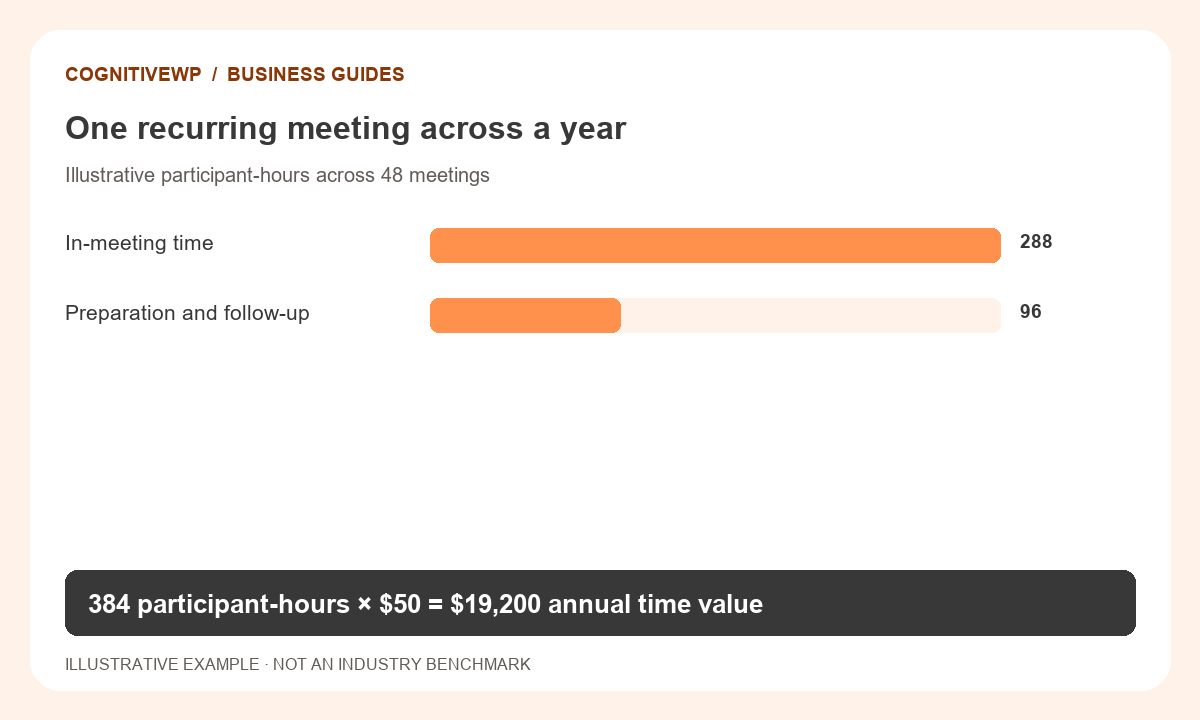
Each meeting uses 6 × 80 ÷ 60 = 8 participant-hours. At $50 per hour, the time value is $400 per meeting. Across 48 meetings, the annual total is $19,200.
Of the 384 annual participant-hours, 288 are spent in the meeting and 96 are preparation or follow-up. Ignoring the latter would understate this example’s total effort by one quarter.
Compare a shorter format without overstating savings
Suppose the meeting is shortened to 30 minutes and preparation falls to ten minutes per person. The same six participants now use four hours per occurrence, valued at $200. Across 48 meetings, the modeled time value falls by $9,600.
That is 192 participant-hours released. It is not automatically a $9,600 reduction in payroll. Whether it becomes a cash benefit depends on overtime, staffing, or other spending changes.
Also check whether a shorter meeting pushes work elsewhere. If it creates extra one-to-one follow-ups, include that effort in the comparison instead of declaring a saving from the calendar change alone.
Use the number to redesign the meeting
A meeting that prevents expensive errors or resolves a critical decision may justify its time. The aim is to understand the trade-off, not to make every meeting as short as possible.
- Write the decision or outcome the meeting should produce.
- Invite the people needed for that outcome.
- Move simple status updates into a readable pre-read where appropriate.
- Reserve live time for discussion and decisions.
- Review whether the revised format achieves the outcome with less total effort.
Track preparation, participation, and follow-up together for a few cycles. That provides a more credible comparison than judging success only by the duration shown in the calendar.
Frequently asked questions
Does canceling a meeting save its full dollar value?
Usually not as immediate cash. The calculation values time released. Cash savings require an actual reduction in spending or a separately supported benefit.
Should preparation be included for every attendee?
Use the average preparation and follow-up effort per person. If only the organizer prepares, divide that effort appropriately or calculate it separately.
Can I use an average salary?
Use a consistent hourly cost appropriate to the attendees. A simple average can mislead when attendance duration or costs differ substantially.
Should I assume 52 weekly meetings?
Use the expected actual number, allowing for holidays, cancellations, and seasonal schedules. The example uses 48 solely as an illustration.
Does a low-cost meeting mean it is effective?
No. Cost and effectiveness are different. Review the quality of decisions and outcomes alongside participant effort.
Related calculators and category
Find a tool for your next business decision
Explore free calculators to compare costs, capacity, and planning assumptions.