 Find a calculator ↗
Equipment Electricity Cost: Convert Watts and Operating Hours into a Useful Estimate
Equipment electricity cost estimates the energy used by a device or group of similar devices. You need power, operating time, and the relevant price per kilowatt-hour. Rated power alone does not tell you the annual cost.
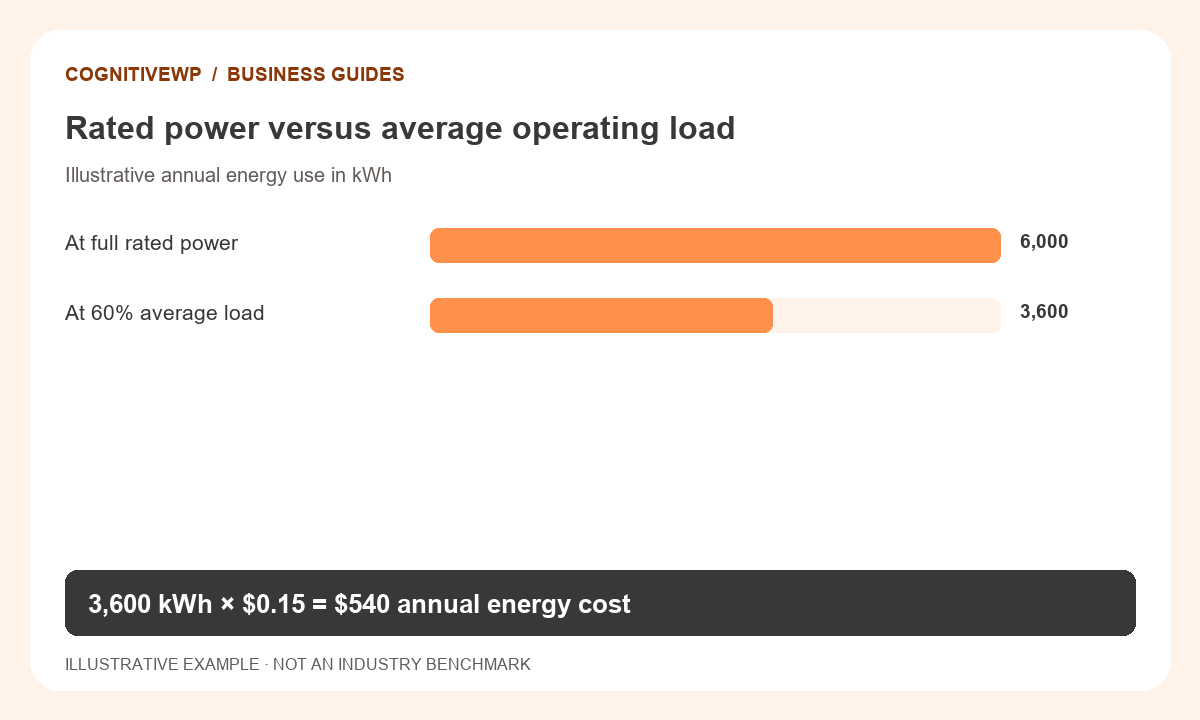
Keep power and energy separate
Watts describe power: the rate of using energy at a point in time. Kilowatt-hours describe energy used over time. A 1,000-watt load operating for one hour uses one kilowatt-hour.
A device’s nameplate can show a rated value rather than the average power it draws in your actual workflow. Equipment may cycle, idle, or operate below its maximum load.
Use measured average watts when available and appropriate. In that case, set the calculator’s load factor to 100% so the average is not discounted a second time.
Build a realistic operating schedule
- Choose one device type with comparable operating behavior.
- Enter rated watts with a justified average load factor, or measured average watts with a 100% factor.
- Count operating hours per day and actual operating days per year.
- Use the relevant energy rate from your electricity bill or tariff.
- Model different equipment groups separately and add their energy totals.
If a device uses energy outside its main operating hours, include that standby use separately. A model based only on active hours will not capture an overnight load.
Do not guess that every device operates at full rated power all day. Equally, do not apply a low load factor without evidence just to produce a smaller estimate.
Worked example: ten similar devices
| Input | Value |
|---|---|
| Rated power per device | 300 watts |
| Number of devices | 10 |
| Operating schedule | 8 hours/day, 250 days/year |
| Average load factor | 60% |
| Energy price | $0.15 per kWh |
Rated combined power is 300 ÷ 1,000 × 10 = 3 kW. At a 60% average load, modeled operating power is 1.8 kW. Across 2,000 operating hours, annual energy is 3,600 kWh.
At $0.15 per kWh, annual energy cost is $540. The monthly average is $45, although actual monthly use may vary with the schedule. The rate is illustrative, not a local tariff or market average.
Know which bill charges are outside the model
This calculation estimates usage-based energy cost. A business electricity bill may also contain fixed charges, demand charges, taxes, and time-dependent rates. Multiplying annual kWh by one price does not model all of those items.
If rates vary by time of use, split consumption into the relevant periods and apply each rate separately. An average price can support a rough estimate, but it may not show the value of shifting equipment use from one period to another.
Demand is a different quantity from total energy. Lowering annual kWh does not by itself establish a reduction in a billed peak-demand charge.
Compare a change using the same scope
If average operating load in the example fell from 60% to 50% at the same schedule, modeled energy would become 3,000 kWh. The difference is 600 kWh, worth $90 at the stated usage rate.
That comparison is useful only if the devices still perform the required work. Lower consumption caused by doing less work is not the same as improving efficiency at the same output.
- Use the same operating schedule for a like-for-like comparison.
- Include standby use consistently.
- Compare installation and maintenance costs separately.
- Use measured performance to check the estimate after a change.
For lighting projects, the related payback calculator provides a separate framework. Review its assumptions rather than transferring an equipment estimate directly into a lighting decision.
A two-mode example: active work and overnight standby
Some equipment uses electricity even when it is not doing its main job. Model active use and standby separately when their power levels differ.
Consider one device that averages 120 watts during eight active hours and 10 watts during the remaining 16 hours of a modeled day. Active energy is 0.12 kW × 8 hours = 0.96 kWh. Standby energy is 0.01 kW × 16 hours = 0.16 kWh.
Total energy is 1.12 kWh for that day. At an illustrative $0.15 per kWh, the energy charge is $0.168, or about $0.17.
Avoid overlapping hours
The active and standby periods must not cover the same hours. Adding 24 hours of standby to eight hours of active use would count part of the day twice. If weekends follow a different pattern, calculate those days separately.
In this example, the watt values are already average measured loads. Use a 100% load factor when entering each mode in the calculator. Applying another reduction factor would discount the average a second time.
Understand the quality of the input
A nameplate value, a rough operating estimate, and a representative measurement provide different levels of evidence. Label the source of your power input so readers of the estimate understand its limits.
A short observation may miss a device’s cycling or a high-load production period. Use a measurement period that represents the activity you want to estimate, or present separate scenarios when behavior varies.
What a lower energy estimate can—and cannot—show
If standby is reduced, the modeled usage charge may fall. That does not automatically reduce a fixed monthly fee or a peak-demand charge. Keep those bill components outside the simple kWh comparison unless you have modeled them separately.
Also preserve required service and safe operating procedures. This example explains the arithmetic; it does not recommend disconnecting particular equipment or changing its operating controls.
Frequently asked questions
What is the difference between kW and kWh?
kW measures power. kWh measures energy used over time. A 2 kW load operating for three hours uses 6 kWh.
Should I use rated or measured watts?
Use measured average watts when they represent the operating period. Set load factor to 100% for that average. If using rated watts, apply a justified load factor.
Does the estimate include the full utility bill?
No. It estimates usage-based energy charges. Fixed fees, demand charges, taxes, and other tariff details may require separate calculations.
Can I include equipment used overnight?
Yes. Use the appropriate hours and load. If standby and active power differ, calculate them separately and add the energy totals.
Is the example electricity rate a recommendation?
No. Use the relevant rate from your own utility arrangement. The example price exists only to show the arithmetic.
Related calculators and category
Find a tool for your next business decision
Explore free calculators to compare costs, capacity, and planning assumptions.