 Find a calculator ↗
Webinar Cost per Qualified Lead: Measure the Full Campaign Cost
Webinar cost per qualified lead divides the campaign’s assigned cost by the leads that meet your stated criteria. It is more useful than a registration-only metric when you need to understand the cost of reaching relevant potential buyers.
Define a qualified lead before counting results
A registration tells you that someone signed up. Attendance tells you that they joined. Neither automatically proves that the person fits your customer profile or has a relevant buying need.
Choose criteria that the marketing and sales teams can apply consistently. They might include a suitable organization, a relevant role, and a specific follow-up signal. Document the rule before reviewing results rather than changing it to make a campaign look stronger.
In the linked calculator, qualified leads are counted among attendees. If your reporting also includes qualified registrants who did not attend, calculate that broader cohort separately and label it.
Include the work behind the event
- Promotion: advertising, partner placements, and campaign distribution.
- Production: speakers, editing, design, and event support.
- Platform: costs allocated to this webinar.
- Team time: planning, promotion, rehearsal, delivery, and follow-up.
Use a loaded hourly cost to value internal effort. A salaried team still spends time on the campaign even if there is no new payroll payment for the event.
For a subscription platform used across many events, choose and document an allocation method. Charging the full annual subscription to every webinar overstates cost; ignoring it entirely understates the broader campaign cost.
Worked example: registrations are not qualified leads
| Measure | Value |
|---|---|
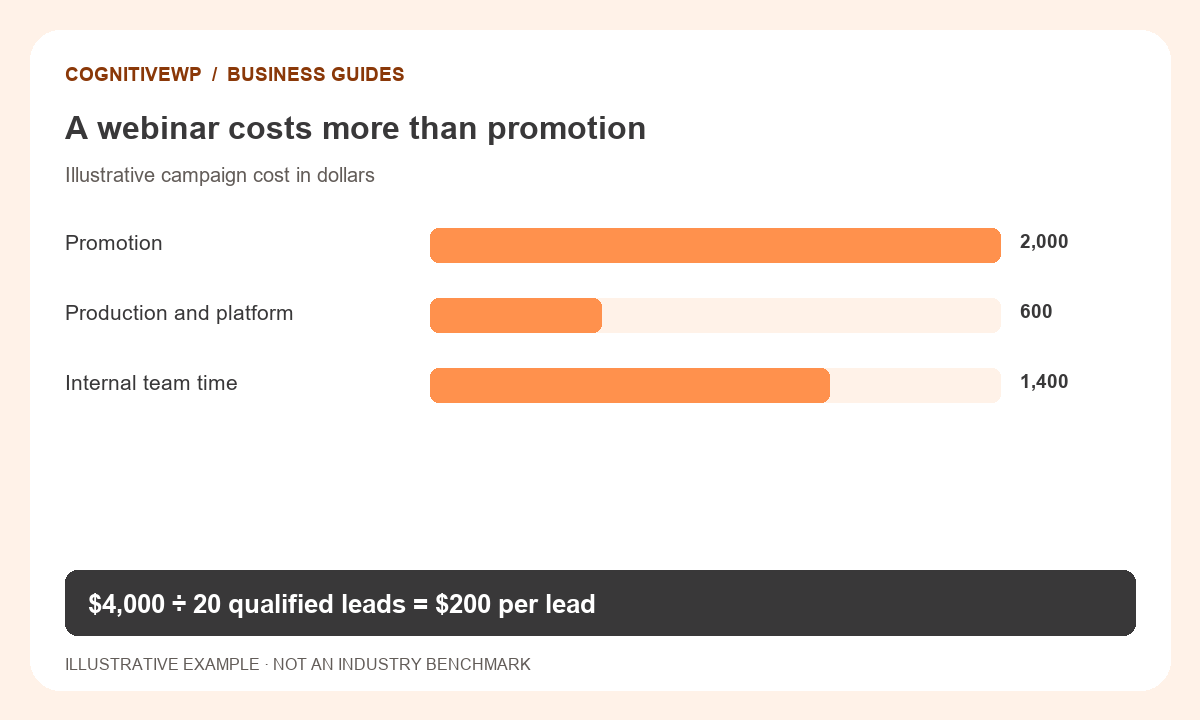
| Promotion | $2,000 |
| Production and allocated platform cost | $600 |
| Team time: 40 hours × $35 | $1,400 |
| Total assigned cost | $4,000 |
| Registrations / attendees / qualified leads | 200 / 100 / 20 |
Cost per registration is $20. Cost per attendee is $40. Cost per qualified lead is $200. Each number is correct, but each answers a different question.
Attendance rate is 100 ÷ 200 = 50%. Qualification among attendees is 20 ÷ 100 = 20%. End-to-end registration-to-qualified-lead conversion is 20 ÷ 200 = 10%. State the denominator beside every conversion rate.
Set a reporting window and remove duplicates
Some qualification happens after the live event. Set a consistent follow-up window and revisit the result when that window closes. Otherwise, a webinar measured after two days may look worse than one measured after two months.
Count each lead once within the defined cohort. A person who attends twice or uses multiple email addresses should not automatically become multiple qualified leads.
If someone attended several campaigns, your attribution rule determines how credit is assigned. This simple calculator does not establish that the webinar caused the lead or the eventual sale.
Improve the weakest stage of the funnel
A high cost per qualified lead can come from expensive promotion, weak attendance, low buyer fit, or heavy production work. Look at the stages before cutting the budget.
- Check whether the audience matches the topic and offer.
- Compare registration and attendance rates across similar campaigns.
- Review why attendees did or did not qualify.
- Reduce unnecessary production work without reducing usefulness.
- Track sales progression separately from initial qualification.
A lower cost is not automatically better if the resulting leads are less relevant. Pair this metric with follow-up acceptance and later outcomes, using a consistent measurement window.
Compare two webinars without letting the cheapest registration win
Consider two illustrative campaigns. Webinar A costs $4,000 and produces 200 registrations and 20 qualified leads. Webinar B costs $3,000 and produces 300 registrations and 10 qualified leads.
A registration costs $20 for A and $10 for B. Looking only at registrations makes B appear more efficient. But cost per qualified lead is $200 for A and $300 for B.
Neither result establishes which campaign ultimately produces more customers. It shows why the chosen outcome matters.
Make the comparison fair
Use the same qualification criteria and follow-up window for both campaigns. Include the same categories of costs. If one includes internal preparation time and the other includes advertising only, the comparison starts from different definitions.
Also check the audience. A webinar aimed at current customers may have a retention or education purpose rather than a new-lead objective. Do not force every event into an acquisition metric merely because the calculator can produce a number.
Turn a lead goal into a cost boundary
If your own planning limit is $250 per qualified lead and the full campaign budget is $4,000, the campaign needs at least 16 qualified leads to meet that limit. This is $4,000 divided by $250, not a forecast that 16 leads will occur.
Work backward through supported attendance and qualification assumptions to test whether the goal is plausible. Avoid borrowing rates from an unrelated audience or treating a single successful event as a stable average.
Keep a short post-event record
- Final assigned cost and any estimates still unresolved.
- Unique registrations, attendees, and qualified attendees.
- The qualification rule and the date the reporting window closes.
- Follow-up acceptance and later outcomes, recorded separately.
This record makes the next campaign easier to compare. It also shows where a result is incomplete, so the team does not mistake an early snapshot for a final outcome.
Frequently asked questions
What if a webinar generates zero qualified leads?
Cost per qualified lead is undefined when the denominator is zero. Report the campaign cost and zero leads; do not display a misleading zero cost per lead.
Should staff time be included?
Include it when you want a full assigned campaign cost. You can also track cash spend separately, but label the two views clearly.
Can I count on-demand viewers?
Yes, if they belong to the defined cohort and reporting window. Avoid counting the same person again when they also attended live.
Is cost per qualified lead the same as customer acquisition cost?
No. A qualified lead is not yet a customer. Acquisition cost requires a defined customer cohort and the relevant acquisition expenses.
Can I compare this with trade-show results?
Only after aligning cost scope, qualification rules, attribution, and follow-up windows. Otherwise the numbers may not be comparable.
Related calculators and category
Find a tool for your next business decision
Explore free calculators to compare costs, capacity, and planning assumptions.